Many scale insects are serious pests of ornamental shrubs and trees. Obscure scale is an armored scale that feeds by attaching itself to twigs and branches and sucking sap that consists of sugars and starches from the tree. It can infest oak, beech, dogwood, hickory, maple, and willow. I most commonly see it on red maple in our area, especially ones that are stressed in the landscape.
Obscure Scale
(Updated: July 26, 2021, 7:29 a.m.)
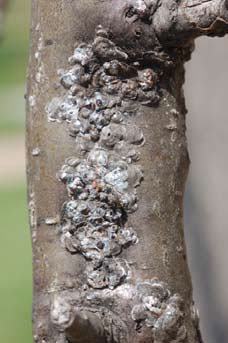
The armor that protects this insect is a waxy covering that it produces that protects them from predators, parasitoids, and pesticides. The protective scale covering is dirty gray in color and closely matches the color of the bark allowing it to blend well so populations may become very large before being detected or a plant shows noticeable damage. Common symptoms of infestation include premature leaf drop and branch dieback. Infestations are common on trees stressed by physical damage, drought, temperature, or improper planting. A severe infestation of obscure scale may weaken a tree causing dieback and decline or at the extreme end can even kill it.
The female lays pink eggs under their armor. When the young hatch, they emerge and crawl around on the plant to find a place to settle and feed. The newly hatched scale are called “crawlers” and are pink so are easy to spot. As soon as they settle, they build their own armor. Armored scales typically do not move once they begin to feed and do not produce honeydew. Often times if you look closely at infested trees you will find layers of dead scales encrusted on branches along with the living ones. Only one generation is produced each year.
If you monitor and can see the crawlers when they emerge you can target them with a contact insecticide. However, It may be better to improve the vigor of an infested tree rather than treat for obscure scales. Take a soil sample from under the infested tree and submit it to the N.C. Department of Agriculture and Consumer Services Soils Lab. If the pH or nutrients are out of balance, the soil should be amended according to the test results. During periods of prolonged drought stress, the tree should be irrigated. Consider killing the grass under infested trees and mulching to conserve soil moisture and keep the roots cool. By getting the tree into top growing condition, it should be less susceptible to the scales and the scales will not reproduce as prolifically. As a consequence, the parasites and predators may control the scales almost completely. If you have a heavy infestation, in the short run, it may be better to spray with one of the horticultural oils to knock down the scale population. Spray with 2% oil during the growing season and 4% oil next winter after the tree is completely dormant.
Join our mailing list!
Enter your email address to receive updates.
Written By