With the hot weather comes a foul-smelling and unsightly seepage of sap from the trunk of shade trees, called Slime Flux. Slime Flux occurs in apple, birch, elm, hemlock, maple, mulberry, oak, poplar, and willow trees. In North Carolina, Slime Flux is quite common in the landscape on large, mature oaks, tulip poplars, and elms. In oaks, the fluxing usually occurs on the lower portion of the trunk, close to the ground.
Slime Flux
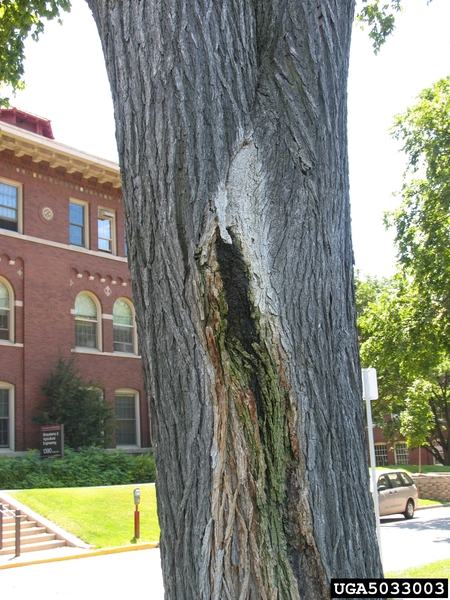
The underlying cause of Slime Flux is a condition called wet wood, which develops when bacteria ferment the sap within the wood. These bacteria enter through wounds, usually in the roots. The affected wood turns dark and appears water soaked. As the sap is fermented, methane and carbon dioxide gases can be produced, and smells somewhat like alcohol. If the internal pressure from the gas becomes great enough, the fermented sap doesn’t just gently seep out of cracks or wounds, but hisses and bubbles and spits, before running down the bark. The flux is colorless to tan at first, but darkens upon exposure to the air. As fluxing continues, large areas of the bark can become soaked.
Many different microorganisms grow in the flux, which results in a foul or alcoholic smell. Various types of insects, including flies, bees, wasps and butterflies, are commonly attracted to it.
Some dieback may occur in severely affected trees, but usually the flux stops after several weeks or months with no apparent damage to the tree. This infection is primarily cosmetic with no real significant injury or setback to tree health. The slime flux may be triggered by heat, drought, or other stresses, so try to maintain good growing conditions. There is no curative treatment for slime flux, but it will do no harm to remove loose bark over the area. Wet wood and Slime Flux are one more reason to avoid causing wounds to tree roots. So install woodchip mulch rings around your trees and keep the lawnmower and weedwhacker away from tree trunks and tree roots.
Join our mailing list!
Enter your email address to receive updates.
Written By