Happy New Year! With the New Year beginning, the dormancy stage of wheat will soon end, which means it is nearing time for tissue sampling.
Wheat Tissue Sampling
(Updated: Jan. 15, 2021, 3:50 a.m.)
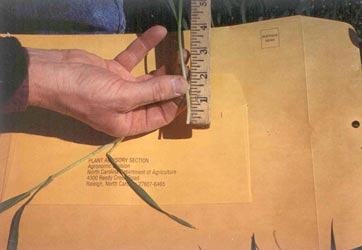
If you are tissue sampling wheat, to send to the North Carolina Department of Agriculture and Consumer Services, timing is everything. The analysis done by the NCDA&CS is made specifically for wheat at Zadoks GS30 (Feekes PS 5). So before you take samples this year check and make sure your wheat is at the right group stage before you take samples so your nutrient recommendation is as accurate as possible. To do this, go into your field and pull a few plants, from multiple areas in your field.
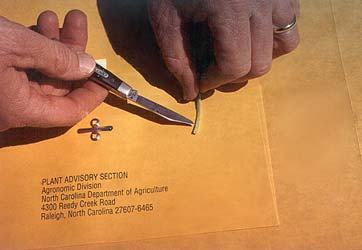
Take a plant and carefully split the stem with a knife starting at the crown to locate the growing Point inside. This growing point will look like a tiny green pinecone. If they're growing point is a half an inch above the crown then your wheat is at Zadoks GS30 (Feekes PS 5) and is at the appropriate time to take tissue samples. Do this for multiple areas in your field to make sure all of the field is at the same growth stage.
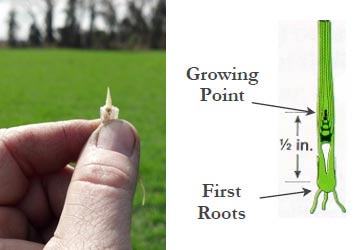
like a tiny green pine cone and is 1/2 inch above the
crown.
If you have any questions or need more information about wheat tissue sampling please contact me at 704-441-2624 or mgraham4@ncsu.edu.
Illustrations are from NCDA&CS.
Join our mailing list!
Enter your email address to receive updates.
Written By